
Nucular X6F vs Our Previous Controllers: Why Every New HPC Build Is Switching
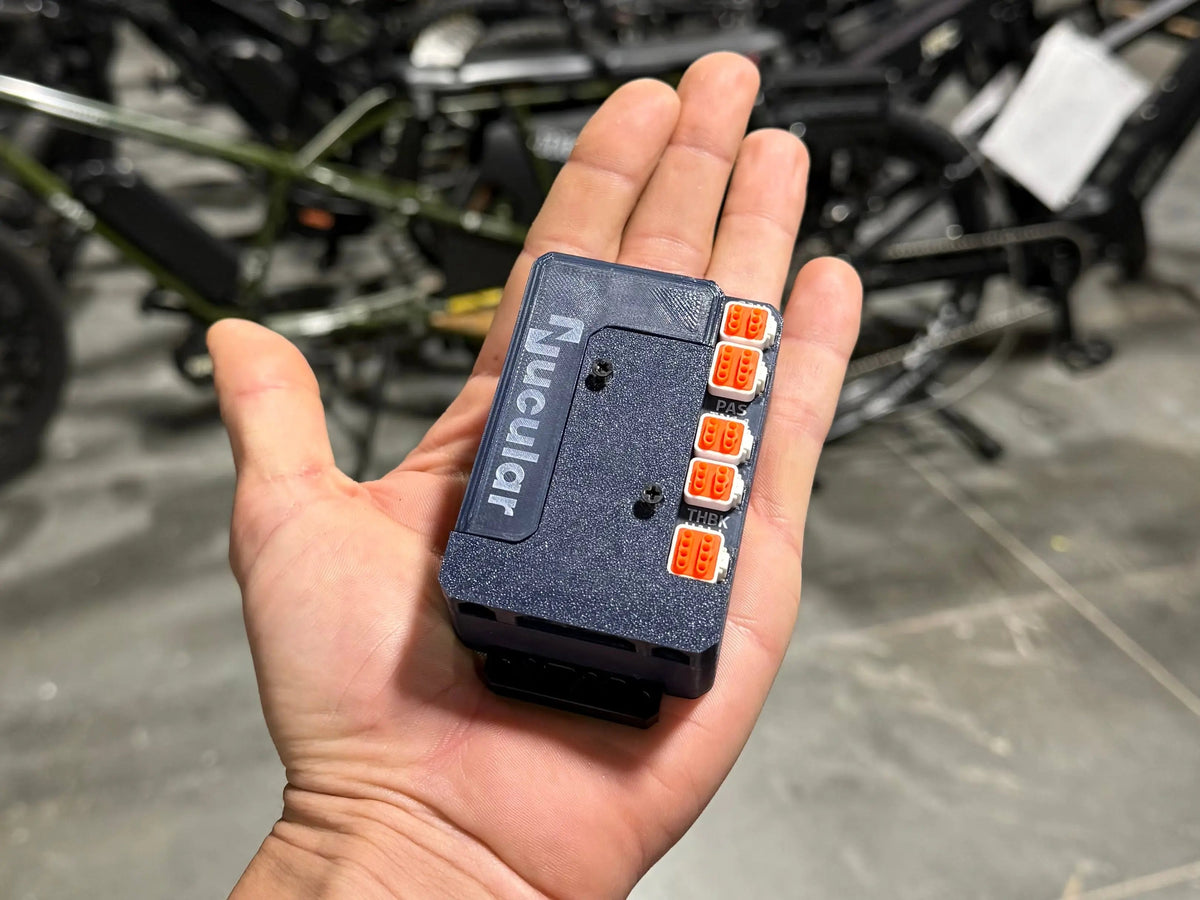
We're making a big change in the shop. Every new Hi Power Cycles build and every conversion kit we ship now uses the Nucular X6F controller. It replaces our previous-generation HPC 2000W and HPC 3000W sine wave controllers. Those controllers served our customers well for years, but the X6F is better in every way that matters. It's a third of the footprint, runs true FOC, offers far more programmability, is more efficient, delivers much more power, and pairs with a far better display.
If you want the product introduction, read Meet the Nucular X6F. This post covers what changes when you go from our old controllers to the X6F, and why we switched.
Old vs new at a glance
| Listed spec | HPC 2000W Sine Wave | HPC 3000W Sine Wave | Nucular X6F |
|---|---|---|---|
| Motor control | Sine wave | Sine wave | True FOC (field-oriented control) sine wave |
| Max power | 2,000W class | 3,000W class | 15kW |
| Battery current | 40A continuous | 50A continuous | 170A max |
| Phase current | 120A | 140A | 250A max |
| Battery voltage | 48V / 52V | 60V / 63V | Up to 90V (21S) |
| Size | 6 x 3.25 x 1.75 in | 6 x 3.25 x 1.75 in | 55 x 34 x 77 mm (about 2.2 x 1.3 x 3 in) |
| Weight | 1 lb 4 oz | 1 lb 4 oz | About 8 oz |
| Display / setup | Cycle Analyst V3, separate programming port | Cycle Analyst V3, separate programming port | Nucular On-Board Computer 2.0 or Bluetooth app |
Specs come from our product pages. Note that the old controllers list continuous battery current while the X6F lists maximum current, so compare those rows as ratings rather than identical tests.
1. One third of the footprint
Our previous controllers measured 6 x 3.25 inches. The X6F measures 55 x 77 mm, about the size of a credit card, which works out to one third of the footprint. It also weighs about 8 oz against 1 lb 4 oz.
On a bike, that matters more than it sounds. A smaller controller is easier to hide inside a frame or battery area, frees up space for a bigger pack, cleans up the wiring, and moves weight off the bike. For conversion kits it means a tidier install, with no bulky box zip-tied to the frame.
2. True FOC sine wave control
Our previous controllers used sine wave drive, which was a big step up from old square-wave controllers. The X6F goes further with true field-oriented control (FOC). FOC measures the motor's state in real time and steers the current so it's always aligned for maximum torque. The result is smoother power from a standstill, quieter running, and more torque for every amp you draw.
For the background on how FOC works, see Why Sine Wave FOC Controllers Power HPC Bikes and E-Bike Controllers Explained.
3. More efficient
Because FOC puts current where it does useful work, less energy turns into heat in the motor and controller. More of your battery's energy reaches the wheel, the system runs cooler on long climbs, and power holds up instead of rolling back when things get hot. That efficiency is what turns into extra range from the same battery and steadier performance on long, hard rides.
The hardware helps too. The X6F uses an 8-layer low-inductance circuit board, low-ESR solid polymer capacitors, top-side MOSFET cooling and a hard-anodized aluminum case that cools directly through the housing.
4. Much more power
This is the headline. Our 2000W and 3000W controllers were matched to those power levels. The X6F is rated for 15kW maximum, with up to 250A phase current and 170A battery current, and it accepts up to 90V (21S) packs where the old units topped out at 48V-63V systems.
You don't have to run 15kW. What the headroom means:
- The controller is working well within its limits on a typical HPC kit, so it runs cooler and lasts longer.
- You can move up to a higher-voltage battery later without replacing the controller. See High-Voltage E-Bike Battery Systems.
- Acceleration and hill-climbing are far stronger when you want them.
5. More programmability
The old controllers worked well out of the box, but changing their behavior meant using a dedicated programming port. The X6F is set up and tuned directly from the Nucular On-Board Computer 2.0, or from your phone with the Nucular Bluetooth module and its Android and iOS app. You can adjust power, throttle feel and battery settings from the handlebar or your phone, without a laptop or cable.
It also connects to the rest of the Nucular system, including the Nucular Ergonomic Thumb Throttle, which can also be set up as a regen brake lever, and the Universal Thumb Throttle / Regen Lever. Learn more about regen in Add Regen Braking.
6. A far superior display
Our previous builds used the Cycle Analyst V3, a capable meter for reading power and battery data. The Nucular On-Board Computer 2.0 does all of that and also serves as the control center for the controller itself. You can read your data, switch settings and tune the system from one screen. It comes with a GoPro-style fork mount, runs the latest firmware in English, and can power a phone, GPS or camera through the optional Nucular USB 5V charge adapter.
What this means for your next build or kit
From now on, new HPC builds and our High Performance Hub Motor Conversion Kit ship with the Nucular X6F. You get a smaller, lighter, more efficient and much more powerful system without changing anything else about how you order. If you already ride one of our previous-generation controllers and want to talk about moving to the X6F, contact our team and we'll help you work out what your setup needs.
Already running a high-power build? The X6F's bigger sibling, the Nucular P24F, is rated up to 27kW and runs our 80 MPH Revolution W. Read Nucular P24F: Full Specs, Wiring and HPC Builds.
Ride responsibly
A 15kW-capable controller can take a bike well beyond the legal definition of an electric bicycle. Set power and speed to match where you ride, use street-legal limits on public roads and paths, and save full power for private land and off-road areas. Our guide to street-legal fast e-bikes explains the classes.


Comments