
The State of the E-Bike Market & Laws for 2027: What We Learned at Sea Otter Classic
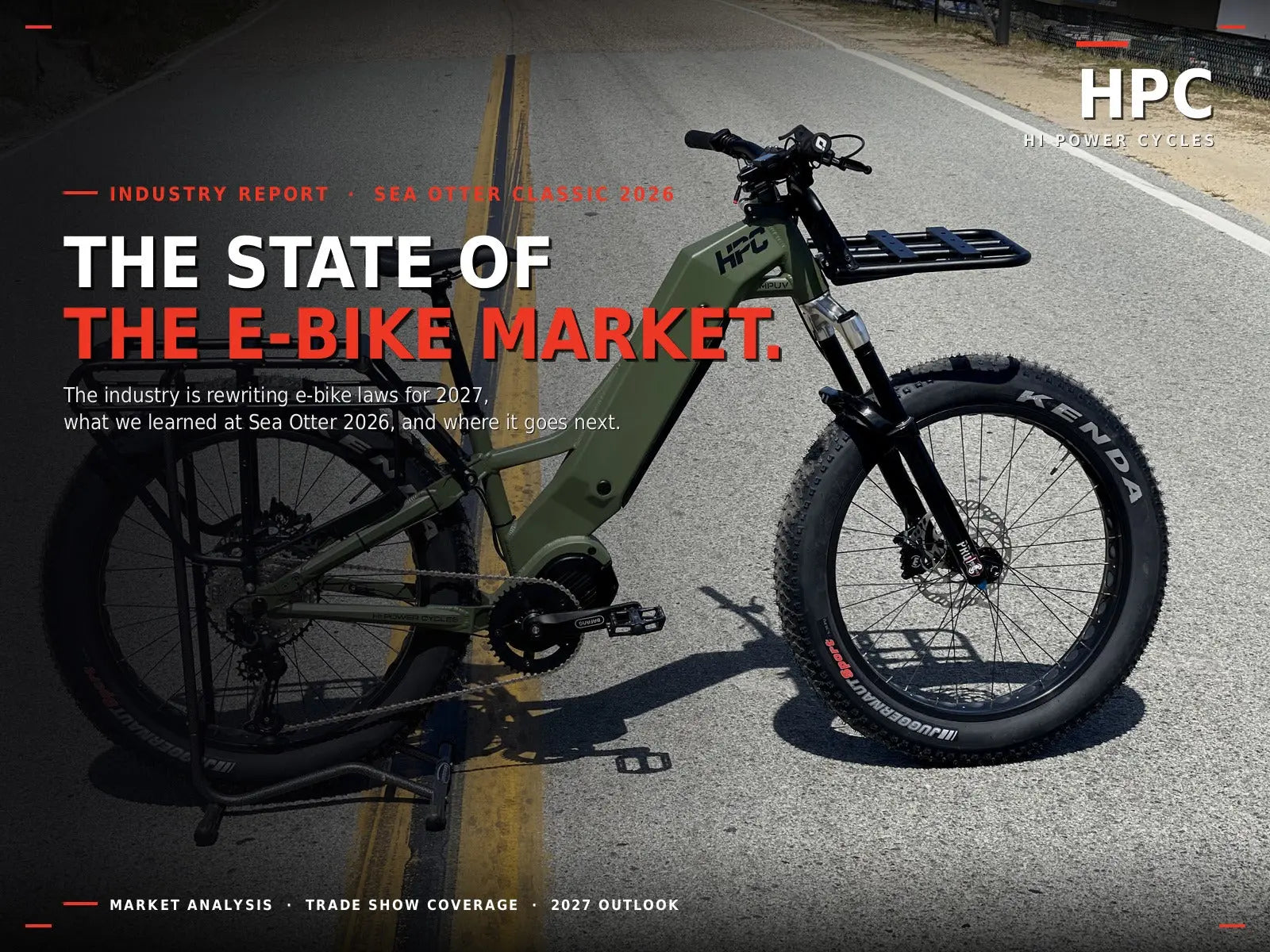
The State of the E-Bike Market & Laws for 2027:
What We Learned at Sea Otter Classic
After 18 years of building high-power American e-bikes, the industry has finally caught up to what we have been saying since day one. Riders want power, and the brands who spent a decade fighting it have quietly sold out and followed us in.
The name on the building has always been Hi Power Cycles. That was not an accident. It was a bet, placed in 2008, that the future of electric bikes was not going to be 250W pedal-assist commuters with faux-wood fenders — it was going to be real performance machines built for riders who actually ride. For the better part of two decades, we took heat for that position. Kicked out of races. Dropped by suppliers. Locked out of OE accounts the second our Trailblazer lineup crossed 750W. This year at Sea Otter Classic, we watched the entire industry quietly walk across the line we have been standing on the whole time.
The Tide Has Turned on High-Power E-Bikes
Walking the floor at Sea Otter in 2026 was surreal. The booth that has historically been the biggest, loudest, most crowded pavilion at the show — owned by a certain large European automotive-adjacent motor brand you can probably name without help — was practically empty. And not because they cancelled. Because the market moved on.
The disruption from the DJI Avinox motor system lit the fuse. We have our own thoughts on that platform (a conversation for another post), but the effect is undeniable: once a 1,000W-plus mid-drive arrived with polished software and big marketing dollars behind it, every brand that spent a decade sneering at anything over the European 250W nominal power law suddenly discovered they could build high-power e-bikes too. Imagine that.
Every brand that hated anything over 250W sold out for money the moment they realized riders were never going to buy the underpowered e-bike they kept trying to push.
The uncomfortable part of the 2027 landscape is not that those brands pivoted. It is that they pivoted without changing a single thing about their business model. The same suppliers and OE accounts who dropped us because our Trailblazer lineup exceeded 750W now proudly service manufacturers pushing well over 750W — because the big brand told them to. We will be watching closely to see how those relationships get rebuilt, and on whose terms.
HPC has not moved. We have remained steadfast from day one, and we will keep pushing the performance envelope because that is what most e-bike riders actually want. The industry finally agrees with us. Welcome aboard.
E-Bike Laws in 2027: Speed Appears to Be the New Standard
Here is the biggest shift we observed heading into 2027, and we want to be clear up front that this is our read on the industry, not an official regulatory announcement: the U.S. three-class e-bike system looks like it is being treated as a speed-based framework in practice, rather than a wattage-based one. Europe — historically the strictest jurisdiction on the planet for e-bike power limits — appears to be drifting in the same direction.
That is a massive change. For years, the 750W federal cap in the U.S. and the 250W nominal cap in the EU were treated as hard ceilings on what could be sold as a legal e-bike. In practice, those numbers stopped meaning anything the moment major manufacturers started shipping systems that are nominally rated at 250W but can pull four to six times that figure under load. If a 1,500W peak motor can be classified as a 250W "legal" motor on a spec sheet, then a 185Nm high-torque platform like ours fits the same framework as long as the bike respects the speed guidelines of its class.
For the 2027 Trailblazer and Trailblazer AT lineup, we are aligning with the class system based on speed, just like everyone else. The difference is we are not hiding behind spec-sheet gymnastics. The power has always been there. Now the rules finally match the reality.
How the Industry Seems to Be Reading the Three Classes
- Class 1: Pedal-assist only, motor cuts off at 20 mph.
- Class 2: Throttle-capable, motor cuts off at 20 mph.
- Class 3: Pedal-assist only, motor cuts off at 28 mph.
From what we are seeing across the show floor and across brand launches, wattage and torque are not being treated as the gatekeeper for whether a bike is road-legal — speed is. This is the direction the industry appears to be converging on, both domestically and abroad, and it is the framework HPC is building toward for the Trailblazer and Trailblazer AT in 2027.
Seven Takeaways from Sea Otter Classic 2026
Beyond the regulatory shift, Sea Otter gave us a clear read on where the industry is heading. Here is what we saw on the ground — and what it means for 2027.
Speed, Not Wattage, Appears to Be the Direction for 2027
From what we observed at Sea Otter and across the industry, the U.S. three-class system is being treated as a speed-based framework in practice, and Europe seems to be heading the same way. This is our read on where things are going — not an official regulatory announcement. For 2027 Trailblazer and Trailblazer AT models, we are aligning with the speed guidelines for each class. If 1,500W mid-drives can be sold as "250W legal," our 185Nm platform belongs in the same conversation — and it is built in America.
The Trailblazer Stood Out Because Everything Else Looked the Same
More than 25 brands launched the exact same power system — identical battery, motor, controller, and display — on the exact same day. Most 2027 e-bikes are copy-paste frames sharing the same silhouette. HPC is committed to its angular design language, more size and build options, more power, USA-built batteries, and staying one of the only e-bike companies that still actually manufactures in the United States.
The Industry Is Stuck at 700–800Wh. We Are Past 1050Wh.
Most e-bikes shown at Sea Otter capped out between 700 and 800 watt-hours. The Trailblazer lineup already ships with more than 1,050Wh, and that number is going up. Range and redundancy are engineering decisions, and we are not compromising them to hit a price point.
The Loudest Anti-E-Bike Brands Now Sell Full E-Bike Lineups
Every brand that spent the 2010s mocking electric mountain bikes showed up this year with a full e-MTB or e-road range. The lack of sales from not offering e-bikes finally caught up to them. The industry is e-bike first now, whether the holdouts like it or not.
The All-New HPC MPUV Was the Hit of the Show
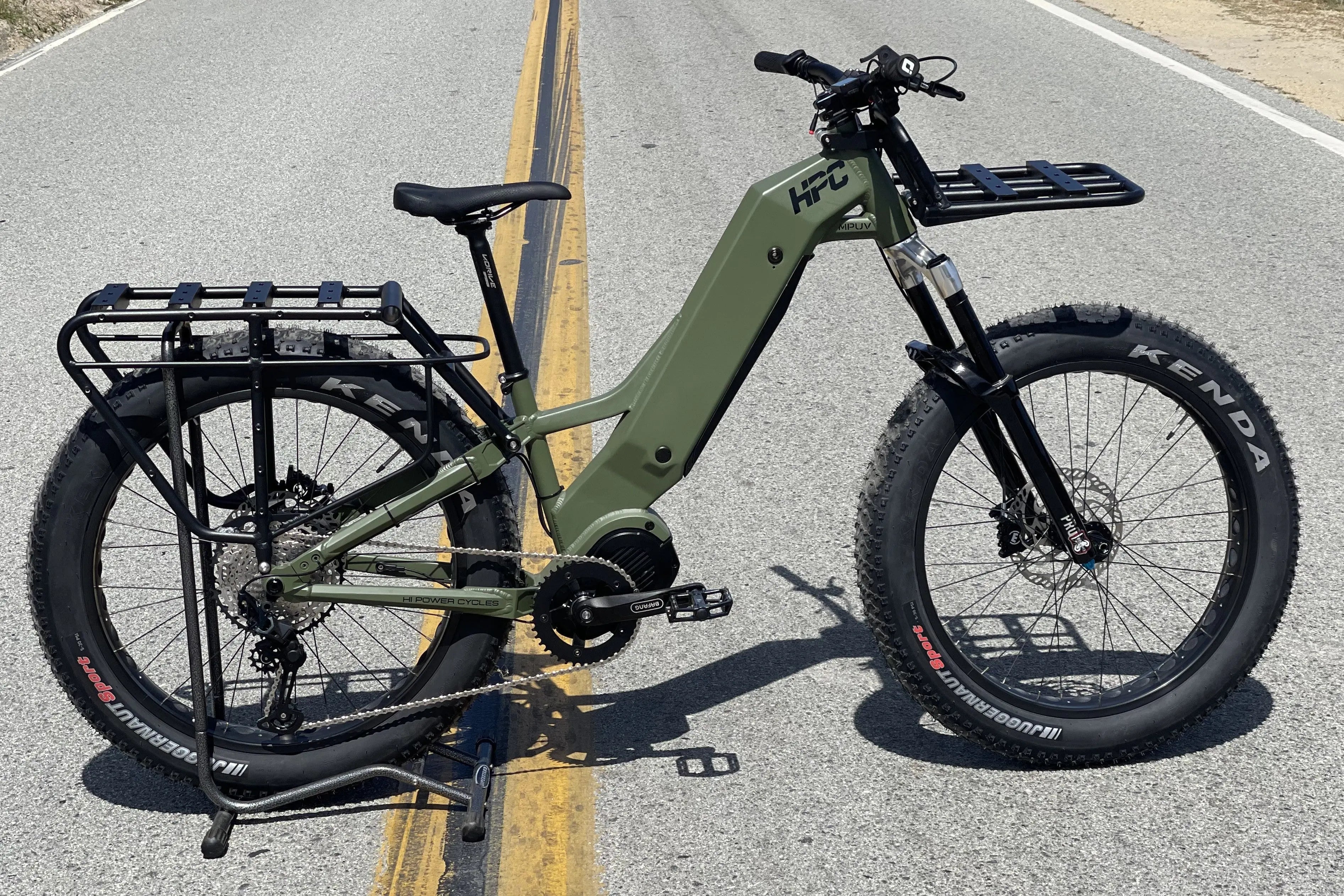
We debuted the MPUV — Multi-Purpose Utility Vehicle — at Sea Otter and the response was exactly what we hoped for. Mid-step frame, 300 lb rear rack capacity, 120 lb front rack capacity, and a full accessory lineup being developed for consumers, military units, police departments, fire rescue, and other government agencies. The utility e-bike category is about to get a lot more serious.
Chinese Brands Made Their First Real Enthusiast Push
This was the first Sea Otter where Chinese manufacturers showed up at the enthusiast level — not just the budget segment. As those brands launched direct-to-consumer channels in the U.S., several established import distributors have already gone out of business. The middleman is disappearing fast.
E-Bike Racing Needs a Decision: Cap It or Go Unlimited
HPC has always raced under a 750W measured wall-to-wheel limit at 20 mph, because we believe fair racing starts with enforceable rules. Right now the discipline is the wild west — there is no practical way to verify the real-world power output of these new spec-sheet-legal systems. The sport needs either a hard cap with real enforcement, or a genuinely unlimited class. Anything in between is a mess.
Want to See a Trailblazer Up Close?
Every HPC bike is assembled to order in our Simi Valley, California warehouse. Configure yours, talk to a human, or come ride one.
Why HPC Is Still the Benchmark in 2027
The last 18 years have been a long argument with an industry that did not want to hear it. High-power e-bikes are not a gimmick. They are not a fad. They are not a liability. They are what serious riders, serious agencies, and serious dealers actually want — and every data point from the 2026 Sea Otter show floor confirms it.
While the rest of the industry was busy cloning each other, HPC kept doing what HPC does: designing our own frames, building our own batteries in the United States, refusing to cap a bike at 750W just because a spec sheet said so, and backing every build with direct human support from Simi Valley. We are the only true American-assembled e-bike company on the GSA Schedule (contract #47QSMS24D005F), trusted by U.S. Special Forces, the Army Corps of Engineers, and the U.S. Air Force. That is not marketing. That is 18 years of compounding decisions.
We are not the brand that caught up to the industry in 2027. We are the brand that sets the benchmark of performance.
HPC FAQ
What makes an HPC Trailblazer different from other high-power e-bikes?
The Trailblazer is built around a specification sheet most competitors cannot match, and every bike is custom built for the customer from the ground up in Simi Valley, California. Core specs and options include:
- 185 Nm peak torque for real climbing and real acceleration
- 2,000W max power output for genuine performance
- 1,050Wh USA-built battery — well beyond the 700 to 800Wh industry norm
- Custom built for the customer from the ground up, not pulled off a shelf
- Backed by a 3-year warranty direct from HPC
- 5-second battery removal for fast swaps and secure storage
- Optional Rohloff internally geared hub capability
- Optional HPC rack system for cargo and touring
- Optional integrated lighting system for all-conditions riding
- Optional full-power throttle capability
- Factory-tuned suspension dialed in before the bike leaves the floor
On top of the hardware, the Trailblazer runs HPC's original angular frame design — not the shared silhouette that more than 25 brands released on the same day at Sea Otter — and every unit is assembled to order by HPC technicians in the United States.
What is the HPC MPUV?
The MPUV is HPC's new Multi-Purpose Utility Vehicle, debuted at Sea Otter Classic. It is a mid-step utility e-bike with 300 lb rear rack capacity and 120 lb front rack capacity, built for consumer cargo use as well as military, law enforcement, fire rescue, and other government applications. A full accessory lineup is in development for release alongside the platform.
Are HPC e-bikes legal for street use?
Yes. HPC bikes are configurable to meet Class 1, Class 2, or Class 3 requirements based on where and how the owner plans to ride. Off-road and closed-course configurations are also available. Our team walks every customer through the right configuration for their state, local ordinances, and use case during the order process.
Where are HPC bikes made?
HPC bikes are assembled to order in Simi Valley, California, using USA-built batteries. HPC is the only true American-assembled e-bike company on the GSA Schedule (contract #47QSMS24D005F), and the platform has been deployed with U.S. Special Forces, the Army Corps of Engineers, and the U.S. Air Force.


Comments